
Building a wall with Biomattone® requires attention to two distinct stages. The first is laying the blocks with bedding mortar. The second is finishing the surface with plaster. In this article we look at the bedding mortars used in the Biomattone® System and how they differ from Malta Fine, the finishing plaster designed for interior spaces.
What is bedding mortar in the Biomattone® System?
Bedding mortar is the mortar used to lay Biomattone® blocks. It forms the joints between one course of masonry and the next. The Biomattone® System offers two products for this stage: Malta e Canapa, a premixed dry mortar, and Malta Pronta, a natural ready-to-use mortar. Both ensure thermal continuity and vapour permeability throughout the masonry, but they differ in composition and application method.
Malta e Canapa: the premixed mortar for laying blocks
Malta e Canapa is a dry powder formulation. It consists of hydraulic and air-setting binders, limestone aggregates, Fine Hemp Shiv 0–6 mm, inorganic pigments and specific additives for adhesion and workability. It is a general-purpose (G) bedding mortar compliant with EN 998-2:2016, with Class M5 compressive strength. Joint thickness can be up to 15 mm. Indicative consumption ranges from 12.5 kg/m² for the thinnest Biomattone® blocks to 25 kg/m² for greater thicknesses.
For application, the mixing water requirement is 20–24%. Working time does not exceed 120 minutes. The mortar has a water-vapour diffusion resistance factor μ of between 15 and 35 and a thermal conductivity of 0.61 W/mK. Its reaction to fire is Class A1, the highest classification under EN 13501-1.
Malta Pronta: the natural alternative for block bedding
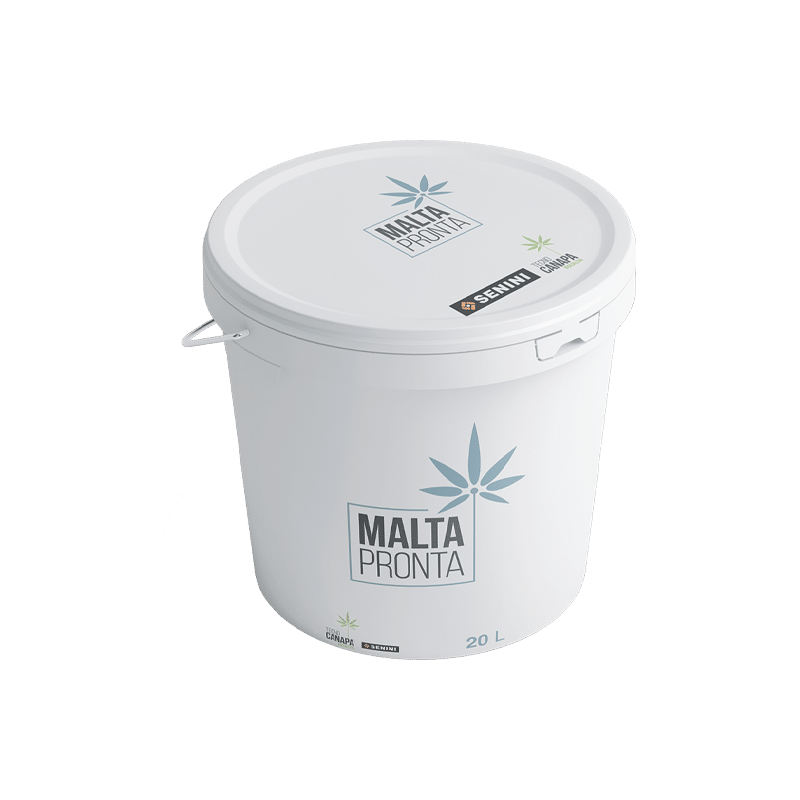
Malta Pronta consists solely of Coarse Hemp Shiv, Natural Dolomitic Binder and symbiotic microorganisms, including the Probiotic Additive. It has a dry density of approximately 500 kg/m³. Thermal conductivity is 0.12 W/mK, with a water-vapour diffusion resistance factor μ of 2.7. It is applied manually, spreading it along the centre of the Biomattone® over at least two-thirds of the surface, to a thickness of approximately 1 cm.
Before application, the block must be dampened by misting with clean water. Once the wall is complete, the joints are tooled. This operation eliminates thermal bridges created by the bedding mortar. Using this technique, wall sections up to approximately 3 metres high can be built in a single operation.
Malta Fine: the fine finish for the Biomattone® System
Once the masonry has been completed with bedding mortar, the surface must be finished. Malta Fine is a ready-to-use finishing plaster based on lime putty and graded sands. It is used as a fine interior finish over base plasters such as Natural Lime Plaster or Bio Beton® 500 Venezia. It is intended for interior use only.
Before application, the surface to be coated must be flat and even. It must also be free from dust, dirt, oil and grease. The dry base plaster should then be dampened before applying Malta Fine.
Frequently asked questions about bedding mortar and Malta Fine
What is the difference between bedding mortar and Malta Fine?
Bedding mortar is used to lay the blocks and form the masonry joints. Malta Fine, on the other hand, is the finishing plaster applied over the base plaster.
How do you choose between Malta e Canapa and Malta Pronta as a bedding mortar?
Malta e Canapa is a dry product mixed on site, with certified performance in accordance with EN 998-2:2016. Malta Pronta is supplied premixed and is designed for natural, fast installation. The choice should be assessed with the TecnoCanapa technical department according to the requirements of the specific project.
Can Malta Fine also be used outdoors?
No. Malta Fine is intended for interior use only.
To learn more about the other stages of the Biomattone® System, including the choice between cast-in-place insulation and blocks, read the article on Bio Beton® Pronto or Malta e Canapa. For technical information, you can also consult the technical data sheets or contact TecnoCanapa Bioedilizia®.